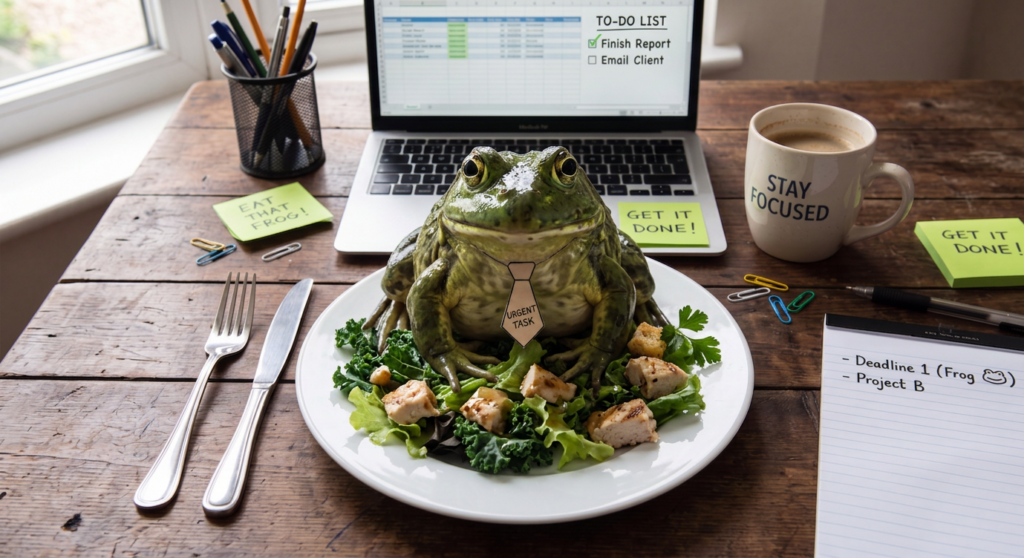
How choosing tomorrow’s hardest first step helped me turn anxiety into structure
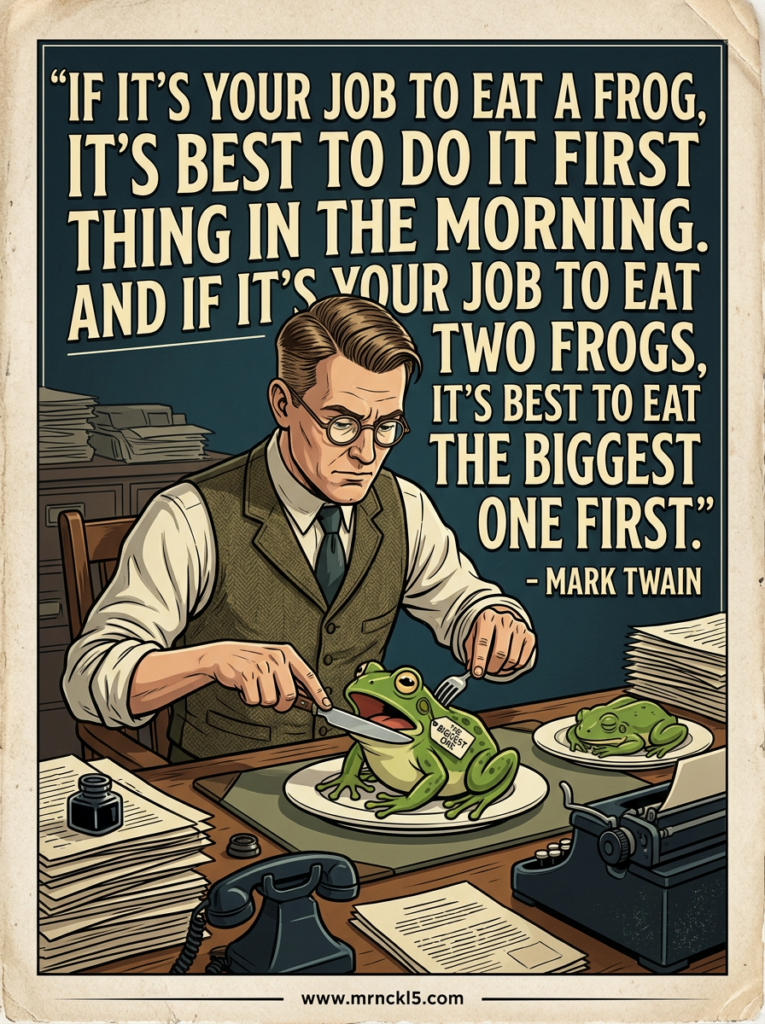
“If it’s your job to eat a frog, it’s best to do it first thing in the morning. And If it’s your job to eat two frogs, it’s best to eat the biggest one first.” – Mark Twain
“Eat the frog” is one of those productivity phrases that has lasted because the image is memorable and the advice is blunt: do the unpleasant thing first. It is often attributed to Mark Twain, though it probably entered modern productivity culture through author/speaker Brian Tracy rather than through literature.
In any case, the phrase endures because it points to something true. Some tasks become psychologically heavier the longer they are delayed. For me, that idea stopped being productivity advice and became a way of managing anxiety.
A lot of the difficulty was never the task itself. It was the atmosphere around it. If there were several things I did not want to do, my mind would keep moving between them, giving each one extra weight. They would follow me into the evening, then into the night, becoming larger in anticipation than they often were in practice.
What helped was not solving everything before bed. What helped was deciding which difficult thing I would do first the next day. That small act of choosing changed more than I expected. It reduced the mental circling. It gave shape to the next morning. It made avoidance feel less like a fog and more like something I could walk through.
Anxiety used to disrupt my sleep badly. At its worst, it contributed to disordered sleep and sleepwalking. I am not presenting a productivity idea as treatment, only describing the scale of what was happening in my own life. What made a real difference was not trying to overpower dread. It was giving the dread less room to expand.
That meant choosing the first task in advance. Over the last three years, that habit has fundamentally restructured my life.
At first, the change showed up mostly as relief. The things that used to cause me stress or anxiety became easier once I stopped letting them sit untouched. Many of them became non-issues. And once that happened, I found that I was not just calmer. I was more productive.
I also became more active.
For a long time, I would drive all the way to the gym after work, sit in the parking lot, and talk myself out of going inside. I told myself I did not have the energy. Over time, that became self-fulfilling. The more often I repeated that story, the more true it felt. Eventually, I really did stop feeling like I had the energy to go to the gym.
After some reflection, I realized I had the sequence backwards. If I waited until the end of the day to exercise, I gave fatigue, indecision, and resistance too many chances to intervene. But if I started my day with exercise, then exercise itself could become the source of energy.
That was where I began to really embrace eating the frog.
It is hard to wake up earlier than I want to. It is harder to leave a warm bed, head out in the dark, get to the gym, and find the will to start running. None of that became easy overnight. But by the end of the first week, I could not deny the effect it was having on both my physical and mental health.
Most days start for me at 3:30 a.m. now. That may sound extreme to most people, and maybe it is. But I get a lot of joy out of running to the gym, walking my dog, and completing two or three errands before 8:00 a.m.
The day feels different after that. Not perfect, not frictionless, but oriented. The early effort creates momentum. It sets me up for success and, more often than not, better outcomes.
I think this works because uncertainty tends to multiply discomfort. A task without a place in the day does not stay still. It grows. It keeps asking to be revisited. It becomes a negotiation I am always half-having in the background.
The task itself may be finite. The negotiation is not. Once I decide that something comes first tomorrow, something changes. The task may still be unpleasant, but it is no longer undefined. It has a place. It has edges. The mind has less room to turn it into an atmosphere.
That, more than anything, is what “eating the frog” gave me: structure. A way to interrupt dread before it could spread itself over everything else. My rule is simple. If something is important, unpleasant, and easy to avoid, it usually goes first.
How to Eat a Frog
Usually, not always. Some things need to be broken down. Some things need support. Some things are not being avoided so much as they are not yet possible. I have found it important to distinguish between resistance and incapacity. They can look similar from the outside, but they ask for different responses. One calls for directness. The other calls for patience, adjustment, or help.
Still, when the issue is resistance, deciding early helps. It keeps avoidance from quietly organizing the whole day around itself. At night, I look at what tomorrow asks of me and choose the thing I am most likely to resist. Then I make the beginning as clear as I can. Open the document. Send the email. Fill out section one. Make the call.
A critical first step is operating with kindness. It reduces the chance that I will wake up and begin bargaining with myself all over again. It lowers the threshold for action. It turns the first moment of the day from a referendum into a continuation of a decision already made.
Over time, ‘eating the frog’ stopped feeling like a trick and started feeling like a philosophy of attention. I spend less time carrying open loops. My mornings are less crowded before they even begin. I waste less energy trying to avoid the knowledge of what I already know I need to do. And, more quietly, I trust myself more.
That may be the deepest change. Repeating this pattern has taught me that I can meet discomfort directly without building my whole day around escaping it. Not perfectly, not every time, but often enough to matter. Often enough that the habit has become part of the shape of my life.
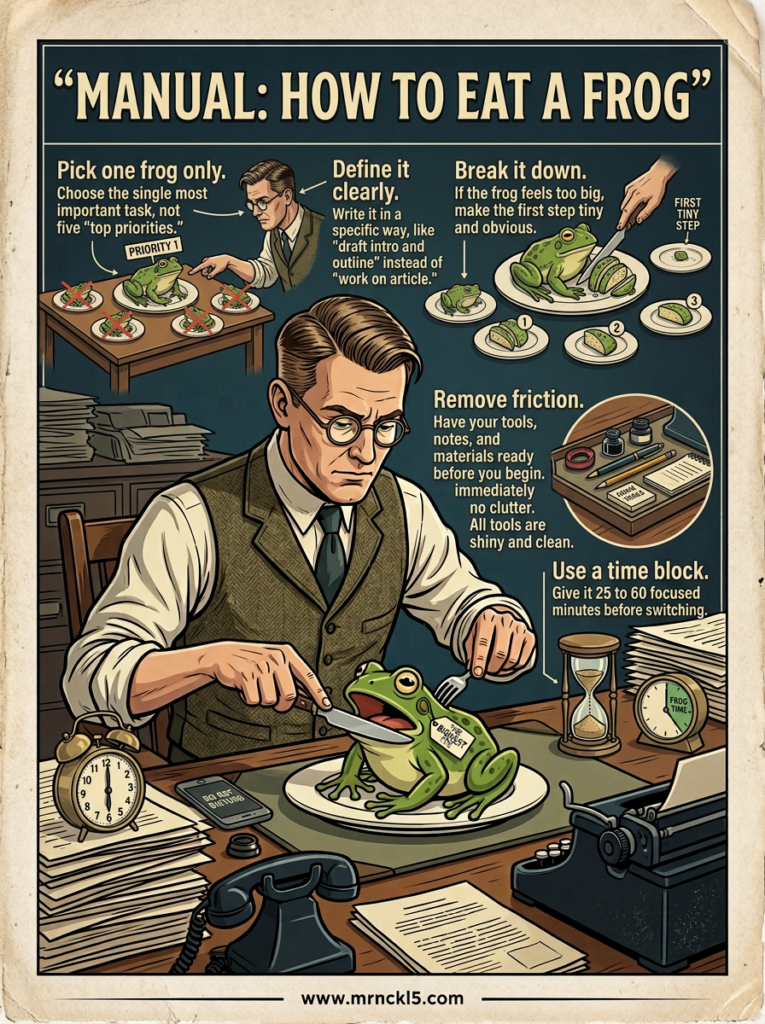
Pick one frog only: Choose the single most important task, not five “top priorities.”
Define it clearly: Write it in a specific way, like “draft intro and outline” instead of “work on article.”
Do it early: Start before checking messages or getting pulled into smaller tasks.
Break it down: If the frog feels too big, make the first step tiny and obvious.
Remove friction: Have your tools, notes, and materials ready before you begin.
Use a time block: Give it 25 to 60 focused minutes before switching.
Avoid fake productivity: Do not replace the frog with easy admin work.
I don’t think every hard task should automatically be done first, and I don’t think productivity advice is treatment for anxiety. This isn’t a fix-all or a cure, and it is not universal. It is only one practice that has helped me reduce the power avoidance used to have over my time, attention, and sleep. But some practices earn their place by being quietly reliable. This has been one of them.
If I know I am going to resist something, I would rather meet it early than let it follow me around for another day, gathering weight in the background. Deciding tonight what comes first tomorrow has turned out to be one of the simplest ways I know to make life feel more stable.
For me, “eat the frog” was never really about getting ahead. It was about ending the negotiation.
He’s waiting for you!
This is an independent article and is not affiliated with Brian Tracy or Brian Tracy International. All images generated with Adobe Firefly.